
Fraud teams are judged on the fraud they miss. Nobody sends a report about the honest customer whose salary transfer was blocked on a Friday evening, who spent an hour on hold, and who moved their money to a competitor on Monday. But that customer is a loss as real as any stolen payment, and usually a larger one, because you lose every payment they would have made afterwards.
A false positive is a good payment treated as fraud. Every fraud system produces them. The question is how many, how they are handled, and whether the system learns from them.
What a false alarm really costs
- The payment itself. A blocked purchase or transfer often does not come back. The customer pays another way.
- Support time. Every block is a call, a chat or an email, and someone has to check the account and release it.
- Trust. A customer who is blocked twice starts to see your product as unreliable, and tells people.
- Your analysts’ attention. A queue full of false alarms is a queue where the real fraud waits longer to be seen.
Why false alarms pile up
Most fraud systems grow by adding rules. Each new rule catches a little more fraud and flags a few more honest customers, and rules are rarely removed. Over time the system becomes more and more suspicious of everyone, including the customers who have used it safely for years.
The fix is not to remove rules. It is to give the system memory: of who each customer is, and of which of its own alarms turned out to be wrong.
Four ways to cut false alarms
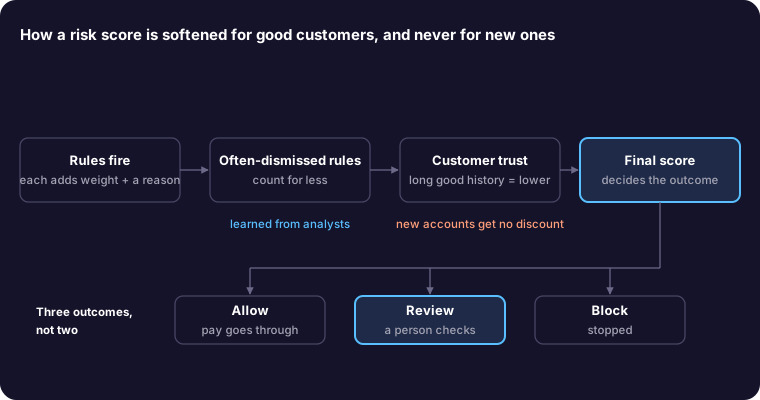
- Use three outcomes, not two. Between Allow and Block there should be Review: hold the payment briefly while a person checks. Most uncertain cases belong there, not in Block.
- Earn trust over time. A customer with months of normal activity should not be judged like an account opened yesterday. Their history should soften the score, and a new account’s should not.
- Learn from dismissed alerts. When analysts keep marking alerts from the same rule as false alarms, that rule is too sensitive for your customers. It should count for less automatically.
- Explain every decision. An analyst who can see why a payment was flagged decides faster, and a support agent can tell the customer something better than "the system said no".
A checklist for your team
- You measure false positives, not only fraud caught.
- Uncertain payments go to review rather than straight to block.
- Long-standing good customers are judged differently from brand-new accounts.
- Dismissed alerts are recorded as false positives, and someone looks at which rules produce the most.
- Every flag comes with a reason your support team can read.
- New rules are tested on past payments before they go live.
Where ArcheaOne fits
ArcheaOne, a real-time fraud detection platform built for African fintechs, was designed to protect good customers as carefully as it stops bad ones.
- Three outcomes, Allow, Review and Block, so uncertain payments get a second look instead of a refusal.
- Decisions that get to know your customers, and your team’s judgement, over time.
- A plain-language reason behind every flag, for your analysts and your support team.
Want fewer false alarms and less fraud? Request access to ArcheaOne.