
Ask a fraud vendor whether you need rules or machine learning and you will usually hear that rules are outdated and AI is the answer. Ask an experienced fraud analyst and you will hear the opposite: the AI is a black box, and the rules are what actually stop fraud. Both are partly right, and the teams that do best stop treating it as a choice.
What each one is good at
| Rules | Machine learning | |
|---|---|---|
| How it decides | Conditions a person wrote | Patterns learned from data |
| Explaining a decision | Easy: the rule that fired is the reason | Harder: needs extra work to show which factors mattered |
| Reacting to a new attack | Same day: write a rule | Needs examples of the new attack first |
| Catching what nobody thought of | Poor: only checks what it was told to | Good: spots behaviour unlike the rest |
| Data needed to start | None | Enough history, and labels for some kinds of model |
| Main risk | Grows into a tangle that flags too many good customers | Confidently wrong, with nobody able to say why |
Rules are how you encode what you already know: your limits, your regulator’s expectations, the attack you saw last week. Machine learning is how you notice what you do not know yet. You want both, but how you combine them matters more than either one.
The question that matters: who gets the final say?
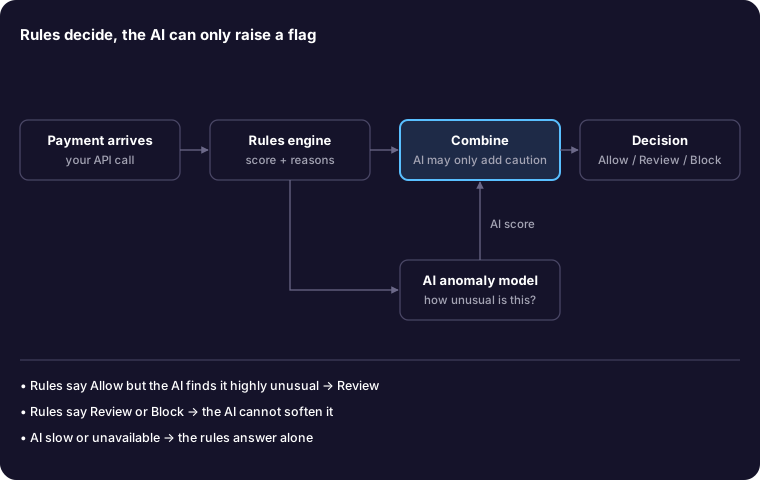
When a rule says Allow and a model says "this looks very unusual", something has to win. When the model is down or slow, payments still have to be decided. Those two cases decide whether your AI makes you safer or just makes your system harder to explain.
A sensible starting point is simple. The rules make the decision. The model can add caution, moving an Allow to Review, but it cannot remove it: it never turns a Block into an Allow. And it cannot block on its own until it has been proven against your own confirmed fraud. If the model is unavailable, the rules carry on alone and nobody’s payment waits.
Mistakes we see
- Letting a new model block on day one. A model trained on someone else’s data, or on a few months of yours, will be wrong in ways nobody has seen yet. Let it flag for review first and measure how often it is right.
- Letting the model override the rules in both directions. If the model can turn a rule’s Block into an Allow, your compliance rules are only as good as the model’s worst day.
- No plan for when the model is down. A fraud check that waits on a slow model holds up every payment. Set a time limit, and fall back to the rules when it is reached.
- Training on data without outcomes. A model that never learns which of its flags were right does not improve.
A checklist for your team
- You know which component makes the final decision when rules and model disagree.
- Your model cannot turn a rule’s Block into an Allow.
- A new model starts by flagging for review, and you measure how often it is right before it blocks.
- There is a time limit on the model, and the rules decide alone if it is slow or down.
- Every decision has a reason a person can read, including the model’s part in it.
- The model is retrained on your confirmed outcomes.
Where ArcheaOne fits
ArcheaOne was built on this principle: rules you control, AI that adds a second pair of eyes, and a clear reason behind every decision. It is a real-time fraud detection platform built for African fintechs, and it gets sharper as your own data grows.
Why the data behind the AI matters as much as the AI itself is the subject of Fraud Models Don’t Fail, They Starve.
- Rules your team can read and change, without waiting on a vendor.
- AI that notices what nobody thought to write a rule for.
- Payments that keep flowing, with a decision your analysts can explain.
Want to see rules and AI working together on your traffic? Request access to ArcheaOne.